
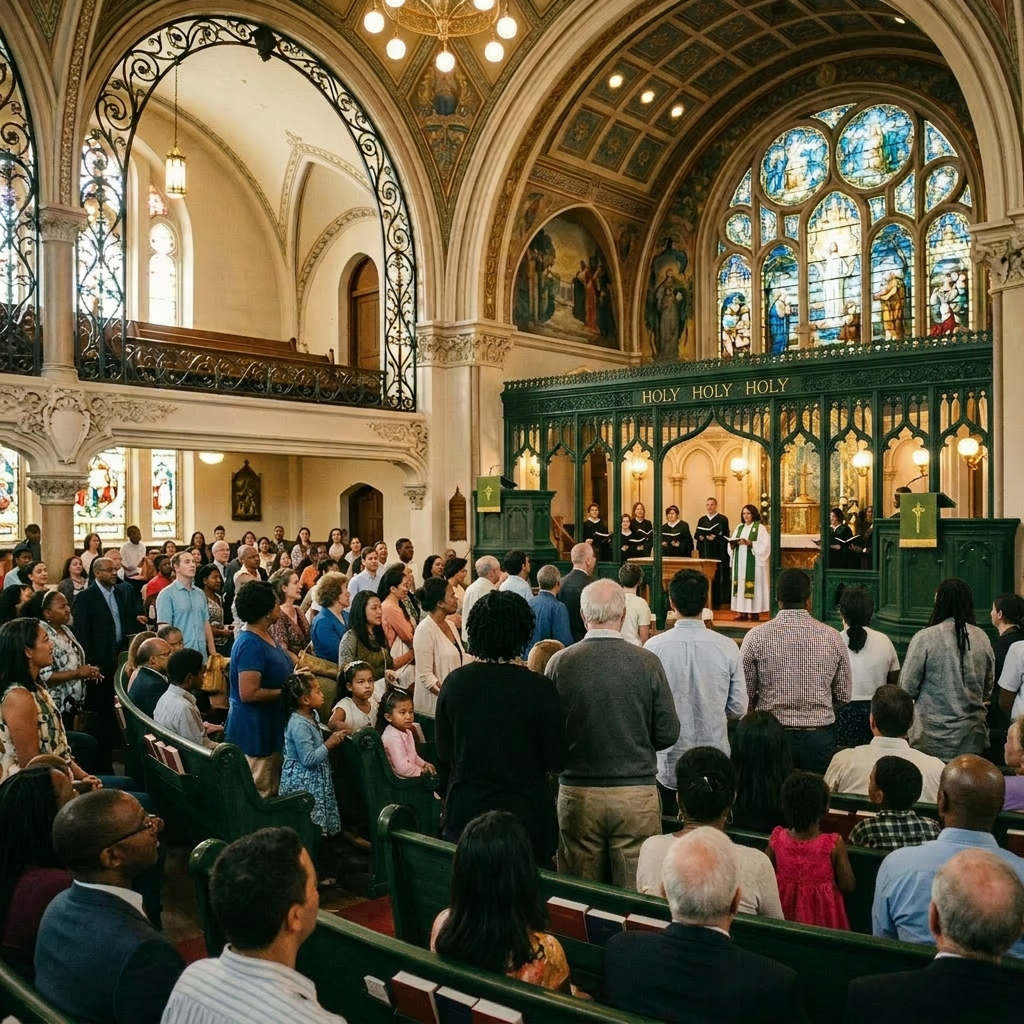
I am now part of the congregation of my local Anglican church in West London, where I have been welcomed. It’s very “high.” At first glance, it’s barely distinguishable from a Roman Catholic Church. There are bells, smells and signs of the cross. There are even icons. The Sunday service is a “mass” and the vicar – incumbent for thirty years – is called “Father”. During the run up to Easter, the statues of Christ and various saints were veiled with purple cloths.
There’s a large congregation of all ages. It is genuinely diverse (not using that word as code for “non-white”) and sits at the heart of the local community; organising local arts and literature festivals as well as musical events in the church itself. The vicar has a musical training and one of his assistants worked in the Royal Opera for many years. The vicar is also chaplain to the local theatre across the road.
The fact that the Lord’s Prayer is longer and that there are two female assistant priests are clues that it’s not the church the late Mrs P. joined. So I am a disappointment, as so often, to her – and also to my Catholic friend, the Navigator.
The bells and smells help me feel closer to my late wife, but I can’t help remember the old Dave Allen joke about the man who died and went to Heaven to be astonished by its diversity. Everyone was there, Christians, Sikhs, Hindus, Buddhists, Jains. He noticed a high wall dividing it and asked St. Peter what it was for. “Behind there,” he answered, “are the Catholics. They like to think they’re on their own.”
If you came to my church and had seen no others, you would think the Church of England was thriving.
Certainly, the life of our rich West London parish is in stark contrast to the precarious existence of the poor parish church in North Wales where my late father was a choirboy, and I was christened and catechised, but not confirmed. Until recently, that church had been without a vicar for years. To reopen it for my father’s funeral, we had to bring one in. My father having lived his whole life in its parish, filled it for the first time in years, but there was no choir to sing for an old member on his departure.
It does now have a vicar again. She is young, leftist, lesbian and shared with another church. She doesn’t process in like our local vicar at the head of a crew of clergy. Her congregation is elderly, sparse and declining.
It’s very much “Low church”. Even the hymns I remember there as a boy were different from those I mumble now. I’ve only recognised two so far in the weeks I’ve been attending in London and the tunes they’re sung to are obscure. Fortunately the excellent organist and choir make my contribution inaudible to anyone but God.
I have enjoyed the sermons I’ve heard so far. One in particular felt like it was written for me. However our vicar reminded me how the Church of England has changed in my lifetime with something he said last Sunday. He mentioned, with disapproval, those marchers at the Unite the Kingdom rally who carried Christian symbols. There was a distinct whiff of contempt for simple folk whose Christianity, while no doubt theologically uncomplicated, I do not personally doubt. I winced a little but consoled myself that God knows their hearts better.
I don’t think the Left has infiltrated the church. I suspect that – as the bourgeoises took control of the Labour Party – they accidentally imported their religious tradition too. A member of the Labour Party in London talking about working people sounds pretty much like an old Tory squire to me. Their contempt for the proles is strong. As one of them said to me (making my blood boil on behalf of my self-reliant, working-class ancestors);
Your mistake is assuming these people can take care of themselves
As the Unite the Kingdom rally showed, that contempt is finally becoming mutual. My late mother-in-law’s lifelong support of Labour never wavered, despite her bemusement over New Labour’s contempt for the likes of her. Her successors would need to be historians to know there ever was a Labour Party that respected them.
Pace my vicar, my sympathies are with the rebels, but I have concerns as to where all this leads. It’s one thing to overthrow a government and quite another to lead one. Especially in the face of an hostile Establishment. Those now rejecting the old parties are not far right but I fear that likely disappointment with the democratic outcome could make them vulnerable to dangerous voices.
The real danger is still from those in the Establishment who scorn the people. They will attempt to subvert the outcome of the next election, as they have shamelessly sought to subvert Brexit. In doing so they may bring the end of democracy.
Those countries in Eastern Europe that overthrew Communism in the last century had the same problem. It was hard to find non-communist expertise to man their government and administration. I take comfort in the fact that, of all those countries, Poland came down hardest. It drew a thick black line under its Communist past and banned former Party members from public office.
I remember working on a privatisation project in 1993 for a young Polish Minister with an even younger staff. As their lawyer, at age 36, I was the wise old man of the group. There’s hope in the thought that – once led by those youths – Poland is now unarguably the most successful of all those countries. What worries me is that the Communist apparatchiks of 90s Poland knew they were beaten. I am not sure the Leftist Deep State in Britain does.
I fear the worst but hope for the best for my country and its people. I cannot imagine what role my church will play in our future, but it will be interesting to watch.










Leave a Reply