THE LAST DITCH

Can I just say that I will never buy from any store displaying this smug, stupid sign? It is an attempt to befriend the cretinous anti-capitalists who are attacking businesses who have so structured their affairs as lawfully to minimise their taxes. The cretins are attacking not merely capitalism but the Rule of Law itself – the very basis of civilisation. If you don’t support the principle that the law is more than just whatever the rulers say, you are a barbarian and no friend of mine. I will defend to the death your right to hold that wicked view – and mine to shun you for it.

Boycott!!
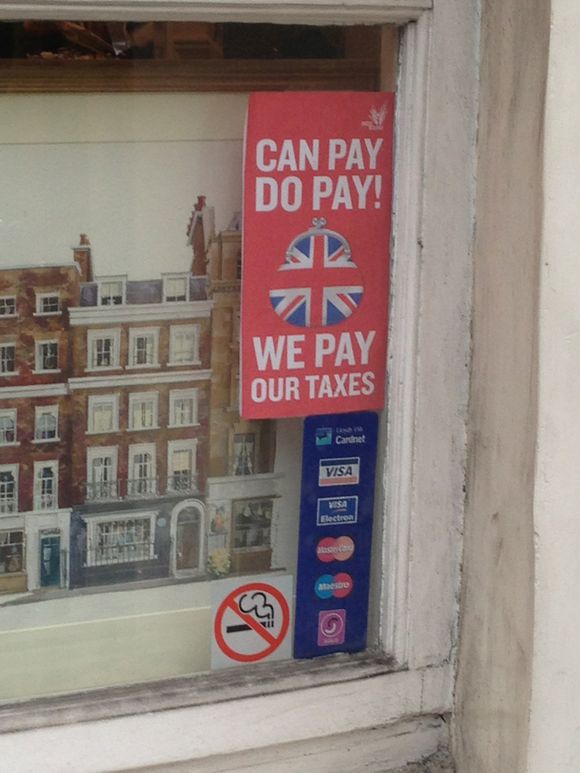
Boycott the Marxist roaders!

15 responses to “Boycott the Marxist roaders!”

  1. Diogenes Avatar
    Diogenes

    Just to be clear Tom. If your accountant gave you the choice of paying £50 000 in tax to the UK exchequer or £49 950 into the coffers of the good people of Luxembourg you would go for the latter in spite of your UK residency. Am I correct?

    Like

  2. Cascadian Avatar
    Cascadian

    They would do well to hire a carpenter to replace the rotting window ledge and a painter to paint the frames. Show a bit of pride in the business, get money circulating in the economy, employ people, give the staff a decent raise and write off the expenses against legitimate operational costs.
    Far better than sending money to the wasters.

    Like

  3. Moggsy Avatar
    Moggsy

    Diogenes, I am guessing it would be way too much bother to switch all his finances for just 50 UKP, by the time you allow for the time taken to do it it might cost more – but you would be able to figure that also, so why ask?
    Anyway Tom didnt say he would. Just that it was perfectly legal for anyone to based on the tax rules the UK Government has. If there is a problem with them the maybe the UK Government ought to fix it?
    Or are you saying you might like to pay a few hundred extra and above in Tax, beyond what the law says you have to? Am I correct?

    Like

  4. Tom Avatar

    I couldn’t be bothered for such a trivial amount. I would do it to save half or more though, provided it was (as it could not be under current law by the way) fully legal.

    Like

  5. Diogenes Avatar
    Diogenes

    My point such as it is, is that people and companies make accounting decisions about where they are liable to pay tax. These decisions are not entirely financial, they have a moral component too.
    As I understand it Starbucks and Amazon pay a large proportion of their taxes in Luxembourg as is permitted by law. The people of Luxembourg do not really need such largess so the money is essentially gifted to already wealthy people.
    I begrudge every penny I pay in tax as me and mine receive little in return. But what I do pay I like to think goes to good causes, such as care for those unable to work. By off-shoring my accounts I would ensure that none of my hard earned funds would find their way to the deserving people I pay taxes for. It is therefore, to my mind… wrong.

    Like

  6. Tomsmith Avatar
    Tomsmith

    Tom, have you read te myth of the rule of law by John Hasnas?

    Like

  7. Tom Avatar

    The great bulk of money taxed is squandered; mainly on the payroll vote of conflicted public servants and dependants who are there to ensure the productive can be ruthlessly exploited without exposing the statist politicians to electoral wrath.
    I read somewhere (link anybody?) that of every pound taxed, up to seventy pence goes in administrative overhead. When public servants are paid from the 30 pence left, they then pay part in tax, which goes through the same “fiscal churn” in every decreasing – and pointless -circles.
    Every penny saved from these gangsters for productive use is a win. My basic point remains that these companies have complied entirely with the law. If the politicians don’t like the outcome, they should legislate better. They cannot just mobilise the masses to enforce their will AS IF it were law, as they are trying to do. That strikes at the moral basis of civilisation far harder than tax avoidance.

    Like

  8. Diogenes Avatar
    Diogenes

    Companies have long traded on their moral rectitude (Bodyshop, COOP, GMG, Virgin, Fairtrade, Waitrose etc.) These companies operate in a way which is not merely compliant with the law but is seen to be ethically above and beyond what is required. It is a highly successful marketing technique.
    I see little distinction between a company stating where its products are made and in what conditions, and a company saying which jurisdiction benefits from its taxation.
    Generally I like customers making informed choices.
    I do however draw the line when these ethical imperatives are enforced by Jolyon, Crusty, Arabella and co exercising their perceived right to get in my way.

    Like

  9. Moggsy Avatar
    Moggsy

    Diogenese, I was really just pointing out how I thought your reponse to Tom misrepresented his point and I figured missed the mark a bit.
    I am not sure I agree exactly what if any moral dimension there might be to paying taxes, I see taxes as a sort of cross between a service charge, charity and mugging.
    More shaded towards mugging right now. If you count sales and fuel and energy and flight (holiday) taxes.
    So for me the moral dimension of tax is it should be reasonable. Otherwise I figure it is more like buying an appartment and the service charge quadruples.. That’s not moral if you ask me.
    Ask yourself why a company might decide to base it’s self in a low tax state like Luxembourg and why they become wealthy there because of that.
    Then ask yourself why, if the UK wants to make lots of money through corporation tax it does not drop taxation to competitive levels and boost it’s income. Greed? Stupidity? The desire to punish anyone who succeeds?
    You want to be sure your money supports worthy causes give it to charity, the least efficient way is letting the Government have it.

    Like

  10. Mark Avatar
    Mark

    It is completely idiotic to tax transactions which occur in one country, in another.
    It is utterly idiotic to argue that taxation is justified on the basis that it pays for expenditure.
    There is government expenditure and there might also be taxation to create a demand for money, or to reduce the amount of money, or to reduce certain activities. The level of government expenditure clearly does not rely on the taxation, though.
    What is going to happen here? I earn money in the UK and pay tax in luxenborg? What do I pay them? Pounds?
    What would thy do with hem if they had them?
    Really, really stupid, from all sides – the people urging more taxation in the middle of a slump are morons, and those criticising greater taxation tend to be asking for spending cuts.
    Sad. When they look back on this period of history I think they will view our level of willfull ignorance as a form of immorality.

    Like

  11. Tom Avatar

    I boycott companies that indulge in “corporate social responsibility” bullshit too, so such conduct is no argument for me. Free market transactions are all good, both for the people making the trade (they wouldn’t if they weren’t) and for the wider public for whom each transaction contributes both pricing data and a signal as to whether a good or service they might want in future should be supplied. There is no need to apologise for doing business. On the contrary, all the fools who try to stand in the market’s way should apologise.
    I utterly despise business people who pander either to Marxist hostility (which will never be appeased until we are all slaves consuming crappy products) or to downright anti-trade snootiness. They are doing good in doing business and should not submit to the evaluations of fools who do no good themselves. The price their good or service commands is all the data they need.

    Like

  12. Tom Avatar

    The point is that international businesses (including the law firms I used to work for) generate income in multiple jurisdictions and are able to allocate costs (and in some case direct revenues) as they choose across their borders – subject to anti-avoidance rules against “transfer pricing”.
    If you are a London-headquartered law firm advising a German client on lending to a French company to finance a project in Russia did you earn money in Germany (where it is paid from) or England (where the profits will ultimately be taxed in the hands of the partners or Russia (where perhaps half your team on that job is employed)? And if you decide to invoice the Russian entity set up by the German client (which he might prefer in order to be able to set off the costs against his higher profits in Russia than in Germany) what costs can you deduct? After all management support for the deal was from London. It’s not fair that your own Russian entity should pay higher tax because it doesn’t carry costs that would normally be necessary.
    Your answers to these questions are probably all equally valid, so of course ultimately you answer them in the way that results in the most profit ending up in England to be taxed in the hands of the partners. If you repeat the example, but with a company liable to corporation tax, then it all becomes even more interesting.
    This is a wonderful, complicated, intellectually-challenging “Glass Bead Game” and some of the best brains in the world play it. My advice to anyone intelligent enough to do so is to train as a tax lawyer because they will be the commercial elite for the next decade as Social Democratic governments struggle to rein in the vast spending commitments they made when times were good. Many deals will only make commercial sense with good tax structuring and good tax advice may contribute more to the profit (given the insane level of government involvement in the economy) than, say, producing a better product.
    If Governments want to stop this (and they should, because the worst impact of all is the loss of the best brains in the world to this game) then they should abolish corporation tax (the economic cost of which falls on individuals, whether employees, shareholders or – most likely – customers) and simplify personal taxation. With no corporation tax, you don’t need capital and other allowances, just a straight deduction of production costs. Low flat taxes with no allowances but a high threshold before they bite would make most of the world’s tax lawyers and tax accountants redundant and set them looking for GDP boosting things to do.

    Like

  13. Mark Avatar
    Mark

    So… the expenses are the problem with regards to income or corporation (profit) tax?
    It is impossible to calculate the profit or earnings that someone derives with reference to only one currency…though in fact, in a crude economic sense, the level of profit/earnings are irrelevent – it is not who earns the money which is important, but the general level of economic activity …?
    Hmmmm… so is it the case that taxes on profit don’t make much sense?
    Though perhaps driving he rich from the country with a high income tax might seve a soial purpose?

    Like

  14. Mark Avatar
    Mark

    Actually, I think I see now that profit/income tax is completely idiotic.
    Thanks

    Like

  15. Tom Avatar

    You are right. “Tax incidence” is the key issue. Where does the economic cost fall? On the customers, employees or shareholders of the company, who therefore pay less income tax. As income tax is typically higher than corporation tax anyway, the tax take is actually lower even if companies don’t re-structure to avoid it.
    Then there’s the overhead of collection, the productive time lost to evasion, avoidance and compliance. Its only real purpose is (a) to appease (or fuel) anti-capitalist sentiment and (b) to mask the true rate of income tax, which it disguises as higher prices/lower wages/lower returns on capital.

    Like

Leave a reply to Tomsmith Cancel reply

Tom is a retired international lawyer. He was a partner in a City of London law firm and spent almost twenty years abroad serving clients from all over the world.

Returning to London on retirement in 2011, he was dismayed to discover how much liberty had been lost in the UK while he was away.

He’s a classical liberal (libertarian, if you must) who, like his illustrious namesake, considers that

“…government even in its best state is but a necessary evil; in its worst state an intolerable one.”

Latest comments
  1. Sailorcurt's avatar

    Hate to tell you this, but it’s not going to end until you end it. You think people to whom…

  2. Lord T's avatar

    They are servants. Just not of the public. He gets a full pension because he did his job for his…

  3. alec5384's avatar
  4. Lord T's avatar