THE LAST DITCH

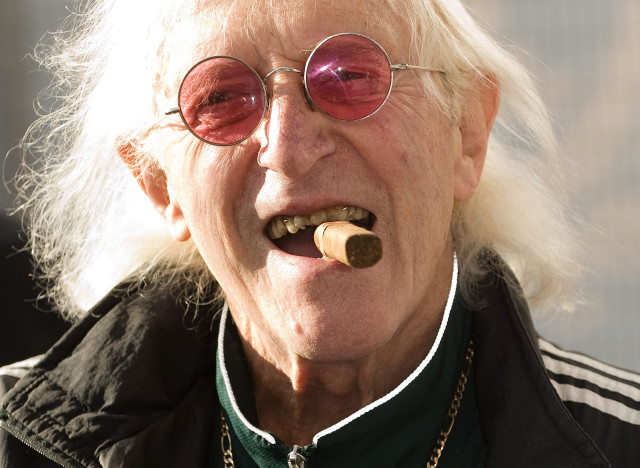
A-JIMMY-SAVILE-640x468I applaud the BBC's decision to allow Panorama to investigate what it knew about Jimmy Savile's misconduct and why the Newsnight story about his alleged paedophilia was pulled. The video is available for a while to UK residents on the BBC iPlayer here:

Any organisation that is not dependent upon its customers, whether a state or private monopoly, will eventually become self-serving. During my career I was party to many conversations about how to maximise profit for the owners of our businesses and provide attractive employment terms for our staff, but they all turned in the end to what our customers would want, or at least accept. We spent much more time worrying how to please customers than please ourselves. Satisfied customers who choose to come back are the only guarantee for owners, managers and workers in the private sector that they can achieve their personal goals.

As will all state enterprises funded by taxation, the BBC has become, in effect, a worker's co-operative. The "customers" have to pay regardless, so they become irrelevant and the focus turns to the interests of its own people. No private business would survive the shit storm that is heading the BBC's way. The share price would now be collapsing as investors tried to get out before the lawsuits begin. I confidently and sadly predict however that the BBC will survive. It has the coercive power of the state behind it and will simply take your money to settle the cases. It is the left establishment's propaganda arm and they will rally to restore its reputation.

We are about to have an instructive, but depressing, demonstration of the realities of modern Britain. We will be able to compare and contrast the BBC news and current affairs teams' handling of this story with their campaign against News International. Just imagine if the phone-hackers had worked for Newsnight and Savile had worked for Sky News!

Predictable though it all was, it was still disturbing to follow Panorama's account of the decision-making process within the Corporation. There was lots of high-falutin' stuff about editorial independence and a clear concern for the BBC's reputation. There was also some po-faced nonsense about depending on the trust of a public that, trusting or not, it will continue to plunder by use of state force. Not one person (apart from those making official statements once the story was out and the lady reporter from Newsnight who will no doubt pay for it when the storm has passed) expressed any convincing concern for their customers-by-force. Some of whom have, it seems, been abused by members of the collective and friends under their protection.

I watched the faces of the people making the allegations and it brought back another memory from the days of watching Jim'll Fix It. I found a girl from my school in a drunken heap at the side of the road on my way home from a date with my girlfriend one night. I tried to help her to go home. It turned out she was in social services care and lived in a nearby childrens' home. When I offered to take her there she begged me not to. She offered sex if I would take her somewhere, anywhere, else. Indeed, "offered" is something of a euphemism. If I had a victim mentality, I would say she attempted rape. I was able to restrain her and decline her offer.

I asked if she had relatives and she told me about an uncle who lived in the area. In retrospect, I worry that she made him up or that her relationship with him was rather different, but I was a naive teenager. I took her to a nearby pub and gave her the money to call him. I left her in the care of the publican, once assured her uncle was on his way.

I later found out that she lived in one of the homes at the centre of a notorious scandal. It rather explained both her reluctance to go there and her use of sex as a currency. I now dread to think what she was going through while I was enjoying a safe and happy childhood. I am ashamed to have ever thought myself hard done to by my strict parents, when I consider what that girl had been put through by the "caring" state professionals paid to look after her.

Here is the fatal flaw in all collectivist thinking; the reason why public service organisations are all more or less corrupt and can never fully be trusted. Here is the reason why Britain's public intellectuals are not merely gullible, idealistic, fools but a serious threat to our welfare.

All organisations funded by force are essentially immoral.

In their detachment from the relentless reality of having to satisfy customers and in their assurance that livelihoods do not depend upon that satisfaction, selfish, abusive behaviours will grow among their staff. Whether in care homes for the elderly, childrens homes, the Parliamentary expenses office, army barracks or police stations bad things will happen not by accident but flawed design. To be clear, I am not saying that public sector workers are all, or even mostly, evil or ill-intentioned. I am just saying that a disproportionate number of the lazy, greedy and wicked in any society will be attracted, as Savile was, to positions they are able to abuse. Nor am I saying there should be no public sector. I am not an anarchist. I accept the need for a state. But here is a strong argument for it to be kept to an absolute minimum.

There is a reason socialist states have always had to resort to prison camps and shootings to maintain discipline and reduce corruption in the ranks. At least, that is, within limits that don't threaten the corrupt gains of their ruling elites. In the absence of Stalinist discipline, what happened at the BBC – the way the collective closed ranks to protect an insider – is not a sad exception to the rule. It is the rule.

58 responses to “The BBC is a worker’s co-operative”

  1. Tomsmith Avatar
    Tomsmith

    “I’m not arguing against property rights – you just don’t seem to understand that the majority of wealth in existance is due to a cultural inheritance – that what we have is never due even in the most part to the work we do, but rather to the institutions, knowledge and machinery we have inherited through pure luck.”
    This is partly correct but not in the way you intend it. There is nothing wrong in the freedom ethic with volunatrily bequeathed inheritance. It is a voluntary transfer and the reasons of the owner in transferring their wealth after death are their own. The main problem with libertarianism however is the historical injustice of much currently owned property. This is a huge issue and very difficult to resolve. Many people choose to ignore it which is not a reasonable thing to do. It does need to be confronted head on by loibertarians and the main ways of doing so are land value tax or horrifically complicated tracing of just and unjust ownership.
    Don’t be too smug though: the alternatives are might makes right or equal ownership of everything for all. The first is difficult or impossible to justify ethically while the second is unworkable practically.

    Like

  2. Tomsmith Avatar
    Tomsmith

    “Now, you are entirely free, despite the existence of this inheritence, to insist that there is no redistribution by government, that the chips be left where they have fallen, that everything will work itself out and that force be allowed in defending this system. However, you can’t rightly tell me that this is the natural order, that everything we own is owed to our own hard work and that therefore the force supporting this system is uniquely justified. All social systems require force. The difference between your system and mine isn’t force – I could simply frame taxation as a defence of each person’s inherited rights, if I so wished – the difference is that you happen to disagree with planned distribution of wealth as a principle of society. All of this talk of “evil” “bandits”, just tells me you really don’t like it.”
    No force is involved in gaining knowledge, or in building upon an already substantial cultural inheritance. Knowledge and culture, once released, are not owned by anyone and are available to anyone who makes the effort. The proceeds of any progress made using already openly existing knowledge or cultural inheritance are indeed owned by the one making the progress and taking the effort under an ethic based on property ownership. To argue against this you need to propose a valid alternative. Your example of taxation as defending a birthright could apply in one circumstance only that I can think of (land), due to the injustioce in current land distribution. Unless you are proposing an alternative political ethic of course.

    Like

  3. Mark Avatar
    Mark

    He has invalidated the argument that having black hair, green eyes and a beard makes you good, but since he is the only one making this argument, I’m not sure of the value of it.

    Like

  4. Mark Avatar
    Mark

    I think the words “justly owned” are doing a lot of work here.
    “be good” is an ethic which can be applied universally, so by using different notions of what is good, any system can be made universal.

    Like

  5. Mark Avatar
    Mark

    In practical terms, we choose one person to do a job — we can’t all work for Sony and therefore take advantage of existing structures, we can’t all start our own company – we can’t all propsper as electronics engineers. This process can either occur within a company or in a decentralised manner through the market – but the message is one of efficiency rather than one of morality.
    It makes sense to have people who are good at jobs performing them – you feel success in this efficiency contest is a moral justification for total ownership. I’m afraid I don’t agree.

    Like

  6. Mark Avatar
    Mark

    Yeah, again, this idea that libertarians are uniquely presenting a system not based on “might”. It would be based on might to the extent which others did not agree with you and you insisted.
    There is another alternative to equal ownership of everything and complete ownership by the perspn performing the work. Equal ownership to the point of necessity and ownership by the person doing he work beyond this point.

    Like

  7. Tom Avatar

    Apart from the “clogs to clogs in three generations” point, the perceived evil of some unjust inherited wealth is mitigated by the positive effects of having fortunes that to some extent balance the power of an over-mighty state. Any attempt to address it by redistribution – whether in pursuit of equality or some notion of just/unjust property – would do far more harm than good. Even assuming the principles of just/unjust allocation could be agreed.
    Yes, there is a vanishingly small group of people who inherited wealth their ancestors obtained dubiously and who have not yet managed to squander or otherwise lose it. So what? The money in question is in play and doing good. They themselves are both economically irrelevant and derive no political power from their wealth any more. We hear a lot more about them than about ordinary people, rich and poor, because their lives are exotic and interesting and because talking about them promotes the envy that statists-on-the-make require to allow them to seize power and wealth for themselves by political force. A force I find no more moral than historical happenstance.
    Perhaps when landed wealth was all that mattered it was a serious problem (as witness the real Tom Paine’s attempts to address it by a land tax to compensate those denied the right to hunt and gather on private land) but it’s an historical curiosity now. These people just don’t matter enough to worry about. Most people who have done well for themselves have been lucky, creative, industrious and/or talented within living memory. Everything I have ever owned (apart from a £1,000 wedding gift from my grandad) was paid for from taxed earnings. So Mark and his merry men can **** right off when they lay claim to it. They have had far too much of it already.
    Most wealthier people (e.g. Mark Zuckerberg) are in more or less the same position. Only the net worth figures vary. And it’s not like the money is gone or the wealth ceases to operate when it’s out of the hands of the collective. On the contrary, government makes appalling use of money in its hands, in general. My complaint about Zuckerberg is that he’s so bloody unimaginative about how to use his money. No art collection, stable of magnificent cars, etc. etc. Rich people have the chance to make the world beautiful in a way that poor people just can’t afford and I like the ones who do, rather than smugly pretend they are happy to be “ordinary.” Pah.
    Can you not imagine the injustice that would be wrought by a commission for the reallocation of property according to just/unjust principles (even if such principles could be agreed)? Or on Mark’s “to the point of necessity” principle? It would be chaos and all positive economic activity would cease while it went on. Certainty about property rights is a precondition of economic security. It benefits all of us, whether we own property or not.
    Reopening historical issues of ownership would be destructive of overall wealth. Uncertainty about property rights is highly damaging. It’s not worth introducing it just to redress historical wrongs that no longer have real social, political or economic impact. Yes the Duke of Westminster never earned his wealth – and nor did any of his ancestors for many generations. But he – at worst – does no harm and may even do some good. Historically his family were great patrons of architecture, for example, rebuilding their stately home for each new Duke. Ironically the state has killed that by making the ugliest Eaton Hall in history a listed building!
    The real point is this. The men of power want you to focus on the rich to distract you from what they are up to themselves. Compared to trillion-guzzling governments, even the richest men are paupers. The elephant in the room is the state and you guys are looking behind the skirting boards at the antics of irrelevant mice.

    Like

  8. Mark Avatar
    Mark

    God, you are so full of shit.

    Like

Leave a comment

Tom is a retired international lawyer. He was a partner in a City of London law firm and spent almost twenty years abroad serving clients from all over the world.

Returning to London on retirement in 2011, he was dismayed to discover how much liberty had been lost in the UK while he was away.

He’s a classical liberal (libertarian, if you must) who, like his illustrious namesake, considers that

“…government even in its best state is but a necessary evil; in its worst state an intolerable one.”

Latest comments
  1. Lord T's avatar
  2. tom.paine's avatar
  3. Lord T's avatar
  4. tom.paine's avatar
  5. Lord T's avatar