THE LAST DITCH

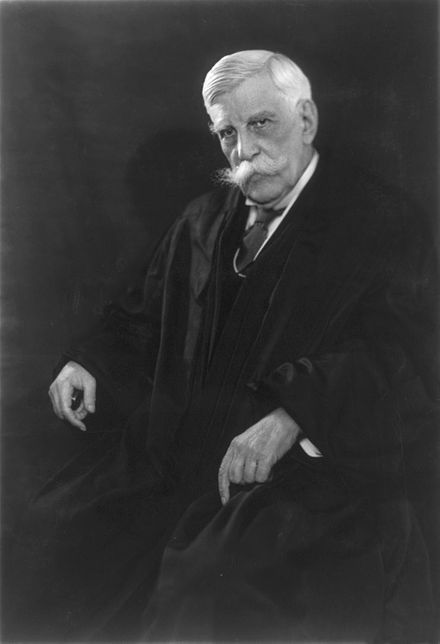
Oliver_Wendell_Holmes_Jr_circa_1930-edit

Oliver Wendell Holmes “The life of the law has not been logic; it has been experience.”

When I studied jurisprudence at university, I was – I discovered – an American Realist. In executive summary, American Realists define law as nothing more than a prediction of what rules the courts in any given jurisdiction will enforce in any given case. There is no moral dimension to it. Law is an entirely practical matter.

As a radical young man, that seemed sensible to me. Now I am not so sure.

Perhaps it was because, as a naive and optimistic young intellectual, I could not imagine the mother of all Parliaments enacting immoral laws. Or the mother of all electorates authorising it to do so. There is no excuse for that youthful lack of imagination because both had already done so on numerous occasions. I make no excuse. As in so many other respects, I was simply not paying enough attention during my studies. 

One notable example of an immoral law was the Transport Act 1947, which seized (amongst other things) my grandfather's transport business. He and his brothers had built it from their own savings from honest employment, supplemented with a small loan from my great grandfather to help buy their first truck. They had committed no crimes (apart from speeding) in the process. They had delivered useful services to the benefit of their fellow men. They had created employment. They had created wealth.

They were also loyal citizens who volunteered to fight for their country the first day after World War II was declared. Their trucks had already been commandeered for military use and returned to them in poor shape. Yet on their own return from the war, their livelihood was taken from them for token compensation, corruptly assessed and paid over decades in inflation-debased coin.
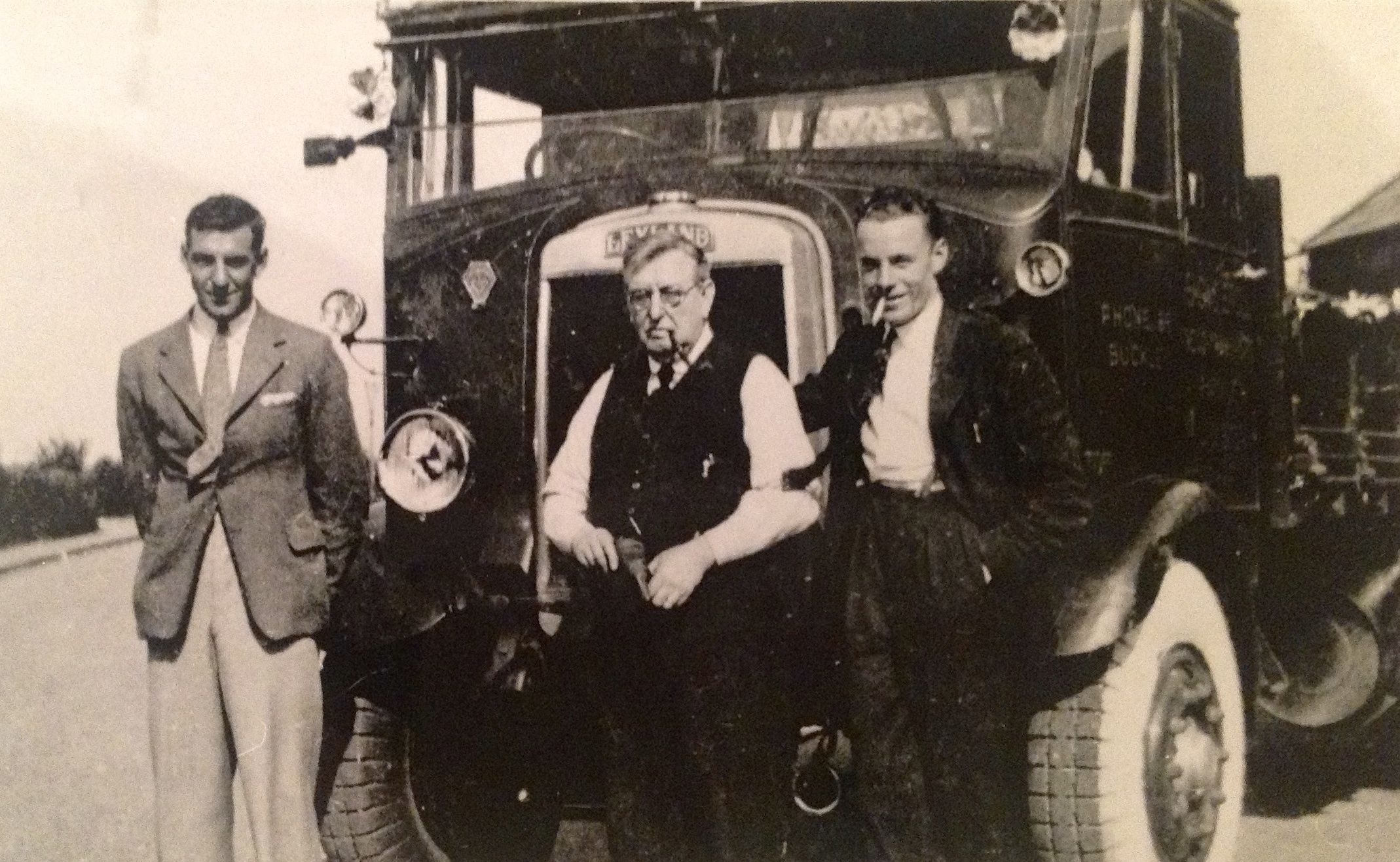
2013-02-21 22-01 page #0

My grandfather, my great-grandfather and the company's first employee

My grandfather, an untutored American Realist it seems, simply accepted it as "good law" (in the sense of valid law) and got on with his life. As a native of a solidly Labour area, he said if he was going to hate the Attlee Government, he would have had to hate all his relatives, friends and neighbours who had voted for it. This, he rather nobly (or perhaps just practically) declined to do. Later in life, with the arrival of Thatcherism in Britain and the fall of Communism in Europe, he was happy to have lived to see the ideology behind his expropriation exposed as an unequivocal failure. It is perhaps as well he did not live to see Socialists regroup under other flags.

Was the Transport Act "good" law in the moral sense? Parliament, so British Constitution textbooks used to tell us for hyperbolic effect (though whether they still do so now Parliament has actually done it I haven't checked) "…can turn a man into a woman…" But can Parliament turn wrong into right; evil into good?

If Parliament voted to legalise the killing of everyone who had ever presented Top Gear, for example, and the Queen gave her Royal Assent (as I predict, based on Her Majesty's conduct to date, she would) would that make it law? For American Realists, the Top Gear Act 2013 would introduce a new defence to the charge of murder and therefore change the correct prediction of what a court would rule if you were charged with killing Clarkson, May or Hammond. So yes, it would be good law. I assert rather shakily (with no philosophical justification to hand) that it would not be "good" law in the moral sense. I sense it's wrong, but I have the same sense about much current law and my sense seems to be out of line with that of my fellow-citizens. They have no moral issues with theft, murder or kidnapping as long as they are blessed by Parliament.

If Parliament can't make bad good, why not? In this democratic age, who else can define what is moral but the representatives of the people? Certainly not the men of religion, who now change their views weakly (if not weekly) with the social tides. If God ever told them what to think, He seems to have lost His voice. Nor do the Philosophy Departments of our Universities offer any useful guidance. On the contrary, they – like other academics – seem now to be mostly paid apologists for the men of power.

Leftists, other statists and their fellow-travellers tell us that expropriation of "the rich" to redistribute their wealth to their chosen corruptees is justified by democracy. Without that justification it would simply be theft. So with such justification would Clarkson-killing cease to be murder? No question, but would it cease to be morally wrong? I need the answer to that question to be "no", but I lack the philosophical equipment to say so. Can you help? Suggestions in the comments section please.

17 responses to “The limits of democracy?”

  1. Andrew Avatar
    Andrew

    An argument’s validity isn’t determined by the amount of support it has.
    Murdering someone because you find him a loud-mouthed, boorish oaf (I’m guessing) is wrong regardless of how many people wish him dead.
    It’s a logical fallacy called argumentum ad populum.

    Like

  2. Tom Avatar

    I buy that. But the point here is more subtle. It’s not – as a matter of law – murder if Parliament has created a specific defence. If good and evil are not determined by the popular will, then by what?

    Like

  3. Andrew Avatar
    Andrew

    By universality, what’s good for one person must be good for all, and what’s bad for one person must be bad for all.

    Like

  4. Michael Avatar
    Michael

    I suggest that if you are willing to entertain the idea of religion as a possible authority on morality, then it would be best to go to the source. While it isn’t difficult to find men of religion who change their views with the social tides, the King James Bible itself has not changed. Furthermore, the value of the Gospel of John, for example, is not that God tells us what to think, but that God shows us how He thinks. This is far more valuable because if you are able to internalize this divine outlook, you can apply it to new situations. And you will know with certainty that the answer to that question is, “no”.

    Like

  5. Mark Avatar
    Mark

    Well, that is the question really isn’t it.
    Are moral differences the result of ignorance of some fundamental law, or is it all just cultural?
    I think the best thing is to view morals as music.
    If there is a universal measure, the best argument isn’t argument, but demonstration of beauty.
    If there isn’t a universal measure then we should seek to amuse ourselves with beauty instead.

    Like

  6. Mark Avatar
    Mark

    Though having said that, I do think it is pretty clear that when push comes to shove, most of us have similar tastes and that therefore learning from others will, in practical terms help us… so we can make moral progress as we learn more…
    I Just that we shouldn’t let the logical argument for complete subjectivity prevent us from acting morally…

    Like

  7. Mark Avatar
    Mark

    We will always be able to imagine those who aren’t moved by beauty, so in that sense beauty cannot be fundamental, and yet we feel that it is …
    I’m with puddleglum…
    “‘One word, Ma’am,’ he said… ‘One word. All you’ve been saying is quite right, I shouldn’t wonder. I’m a chap who always liked to know the worst and then put the best face I can on it. So I won’t deny any of what you said. But there’s one thing more to be said, even so. Suppose we have only dreamed, or made up, all those things–trees and grass and sun and moon and stars and Aslan himself. Supose we have. Then all I can say is that, in that case, the made-up things seem a good deal more important than the real ones. Suppose this black pit of a kingdom of yours is the only world. Well, it strikes me as a pretty poor one. And that’s a funny thing, when you come to think of it. We’re just babies making up a game, if you’re right. But four babies playing a game can make a play-world which licks your real world hollow. That’s why I’m going to stand by the play-world. I’m on Aslan’s side even if there isn’t any Aslan to lead it. I’m going to live as like a Narnian as I can even if there isn’t any Narnia. So, thanking you kindly for our supper, if these two gentlemen and the young lady are ready, we’re leaving your court at once and setting out in the dark to spend our lives looking for Overland. Not that our lives will be very long, I should think; but that’s small loss if the world’s as dull a place as you say.”

    Like

  8. Mark Avatar
    Mark

    What do we find beautiful and what are most other people likely to find beautiful…

    Like

  9. Devil's Kitchen Avatar

    Tom,
    A surprising post for a libertarian to write, I think; after all, the most quintessential belief of libertarianism is the Non-Agression Axiom (NAA), i.e. you shall not initiate force or fraud against someone’s life, liberty or property.
    Of course, the NAA is an axiom: that is to say, it is a philosophical principle from which all else in libertarian thought derives.
    But once that central philosophical tenet is accepted, no amount of “democracy”—which is, after all, merely the tyranny of the majority (or, more pertinently, the tyranny of the mob)—can over-ride that tenet.
    Just because there might be more violent, vengeful, dishonest thugs than libertarians, that does not make those thugs any more right. In fact, it makes them less so: the law is there to protect the innocent against the mob—otherwise, why bother with laws at all?
    Laws exist to protect the disadvantaged—in strength, numbers, intellect, etc.—from being preyed upon by the others (whether through violence, fraud, etc.). If they do not do so, then there is no point in their existence—it would be simpler and cheaper to simply adopt mob rule.
    If mob rule is adopted, then there are no laws since the mob can elect not to follow them. As such, no law can be justified through democracy, since the law exists to thwart the will of the many.
    DK

    Like

  10. Mark Avatar
    Mark

    The non-agression principle is a complete non-starter as long as private property exists, in that picking up a piece of paper may be considered as agression while killing someone may not, depending upon the ownership of the paper.

    Like

  11. Chromatistes Avatar

    Public choice is a notoriously difficult area; Arrow’s Impossibility Theorem highlights a most uncomfortable aspect of it. Despite the strongly-held Libertarian views that are common in Flatland, a part of me hankers for enactment of The Top Gear Act 2013.
    Perhaps Article One, Section 9 of the US Constitution could add, after the wording: ‘No Bill of Attainder or ex post facto Law shall be passed.’ the addendum: …except, of course, in respect of Paul Anka, for the unique crime of having composed ‘My Way’.
    Ko-Ko, your list is in need of augmentation!

    Like

  12. Tom Avatar

    Beauty as truth is attractive but the second part is the problem surely? Most people seem likely, from recent experience, to find the oppression of the productive if not beautiful, at least attractive.

    Like

  13. Tom Avatar

    I don’t think it’s odd. I agree with you entirely about the non-aggression principle. In a state composed of me and thee, all would undoubtedly be well. However we are in a situation where most of our fellow-citizens don’t agree with us. They seem to believe the legitimacy of their aggressive exploitation of their fellow men derives from democracy.
    If – as we libertarians believe – there are moral limits to aggression; limits that apply regardless of whether a majority support it, then we need to explain to our fellow-citizen where those moral limits come from. Navigator says they come from God, but God seems to speak in different voices to different Christian sects – let alone to Muslims, Hindus et al. In my view, respectful though I am of the religious viewpoint, He is either imaginary or not consistently enough understood to be useful
    Most people in modern Britain simply don’t seem to see any moral limits at all and the statist men of power are exploiting that relentlessly. I was not debating if there should be limits or even where they should be – I am entirely of one mind with you on that. I am trying to start a discussion on how they can be established at all!

    Like

  14. Mark Avatar
    Mark

    I think it is fairly clear that most people act from a position of ignorance most of the time – which, incidentally, is why I’m not a libertarian – if I’d never heard the works of Mozart, or been told continuously that those works were boring, I might consider Justin Bieber to be the world’s greatest musician. That wouldn’t mean that I wouldn’t feel differently if I were less ignorant…
    I think we must therefore always have a degree of humility in that our views might be the result of ignorance – personally I feel that the current desire to tax the productive, is a definite result of ignorance – Jimmy Carr sending money to Jersey means that children must die in hospitals? On what possible planet? – but… I could be wrong…

    Like

  15. Moggsy Avatar
    Moggsy

    In the early 19th century crimes like breaking and entering, setting fire to a haystack, and defacing Westminister Bridge were subject to the death penalty.
    If parliament were to enact a Prevention of Top Gear Presenting Act 2013, that made it a crime carrying a mandatory death sentance it is discouaging something it dissaproves of.
    It passes laws that do that all the time. It is only that the penalties are less fierce.
    How would you view it if the punishment were 18 months with parole and a life time ban from TV? Would you go with that?
    Shouldn’t the producers be prosecuted for aiding and abbetting? How about the camera operators? Gofers? ^_^
    Suggestions… How about “Thou shalt not kill”.
    Or The Libertarian principle of Self ownership?
    Those presenters own their own bodies you know. To loose their lives is to loose their futures. To have it taken by state force?
    Or on Pastor Martin Niemöller’s grounds, both moral and enlightened self interest.
    http://en.wikipedia.org/wiki/First_they_came

    Like

  16. patently Avatar
    patently

    Tom, if you want proof that there is no link between the boundaries of legality and morality, then you can (amusingly) look no further than the Statists who put so much effort into decrying the perfectly legal but (allegedly) immoral tax avoidance practices of certain large companies.

    Like

  17. Tom Avatar

    That’s witty but takes the debate no further. I would like to establish a moral limit to the Law. The social-democrats have a “moral” basis for their arguments; they advance “equality” as an axiomatic good and everything else flows from that. It helps them that so many slow-of-thought confuse “equality” with “fairness” and that “equality before the law” (quite a different thing) was accepted (for most of English history until quite recently when super-equal groups emerged) as an axiomatic good. I am happy with “No force or fraud” as an axiom, but how do I root it in recognisable moral soil, so as to persuade my fellow-citizens to adopt it? Especially when so many of them are scared of how their lives would be if ripped from long-accustomed dependence on the state.

    Like

Leave a comment

Tom is a retired international lawyer. He was a partner in a City of London law firm and spent almost twenty years abroad serving clients from all over the world.

Returning to London on retirement in 2011, he was dismayed to discover how much liberty had been lost in the UK while he was away.

He’s a classical liberal (libertarian, if you must) who, like his illustrious namesake, considers that

“…government even in its best state is but a necessary evil; in its worst state an intolerable one.”

Latest comments
  1. Lord T's avatar
  2. tom.paine's avatar
  3. Lord T's avatar
  4. tom.paine's avatar
  5. Lord T's avatar